
BEWARE: graphic description of death
The La-Z-Boy Tomb: The Unfiltered Reality of End-Stage Alcoholism
Warning: This post contains graphic descriptions of death and the physiological effects of severe alcoholism.
We often romanticize the “tortured artist” drinking themselves to death, or we imagine a sudden, dramatic heart attack. But the reality of dying from alcoholism alone in a private residence is a slow, biological horror story that few people talk about until they are the ones opening the door.
This is the story of a scene I will never forget. It is a story of isolation, addiction, and the final, brutal rebellion of the human body.
The Entry
The first thing that hits you isn’t the sight; it’s the air. It is a thick, sweet-sour heaviness that clings to your clothes. It is the smell of stagnant alcohol, ammonia, and organic decay.
She hadn’t been seen for three weeks. The mail was spilling out of the box, and the neighbors complained about a smell. When we forced the door, the sound of glass chinking together was the first noise in the silent house.
The Sea of Glass
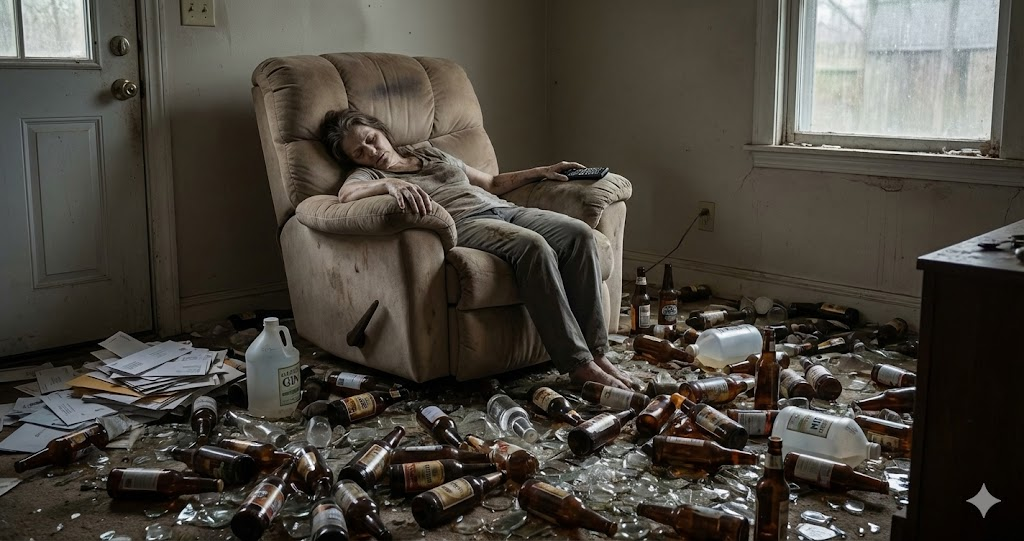
The floor was invisible. It was covered in a topographical map of addiction. There were clear vodka handles, cheap plastic jugs of gin, and hundreds—literally hundreds—of brown beer bottles. Some were upright, some were on their sides, rolling slightly as we walked.
They created a path, a narrow trail through the hoarding of glass that led to the center of the living room. There was no food waste. No plates. Just the bottles. The focus of her life had narrowed down to this single room and this single consumption.
The Chair
In the center of the room sat a beige microfiber La-Z-Boy recliner. This was her throne, her bed, and eventually, her coffin.
She was still in it.
The user asked for the reality of “bleeding out through the pores,” and while that sounds like a figure of speech, in end-stage liver failure followed by unattended death, it is a gruesome physiological reality.
When the liver fails, it stops producing the proteins necessary for blood clotting. The blood becomes thin. The platelets drop. The slightest bump causes massive bruising. In the final stages, the body begins to weep.
She hadn’t moved from that chair in days, perhaps weeks, before she passed. Gravity and decomposition had done the rest. The fluids of the human body—blood, bile, and edema—had leaked from her compromised skin. Because she had passed away in a seated position and wasn’t found for weeks, the process of decomposition had caused her skin to slip and fuse with the fabric of the chair.
She was quite literally stuck to the upholstery. The fluids had saturated the cushion, drying and acting as a morbid adhesive.
The Physiology of the End
She didn’t just fall asleep. The bottles around the chair told the story of a frantic attempt to medicate pain that alcohol could no longer touch.
End-stage alcoholism is agonizing. The abdomen swells with ascites (fluid buildup), pressing on the lungs. The esophagus develops varices—veins that can burst and cause massive internal hemorrhage. The toxins build up in the brain (hepatic encephalopathy), causing confusion and terror.
She likely sat there, unable to stand due to the atrophy of her leg muscles, drinking warm beer to stave off the shakes, while her body slowly shut down system by system. She bled internally, and as the decomposition set in, she bled externally, her body simply unable to hold itself together any longer.
The Silence
The TV was off, but the remote was in her hand, fused to her palm.
There were no pictures of family on the walls near her. Just the bottles. They were her insulation and her walls. She died surrounded by the only things that had been constant in her life for the last decade.
When we finally removed her, the chair had to go with her. It was a biohazard, indistinguishable from the remains.
This is the reality of the disease when it is left to run its full course in the dark. It isn’t a peaceful fade to black. It is a messy, painful, and profoundly lonely disintegration.

Leave a Reply
You must be logged in to post a comment.